
Food forests are based on ecological science that studies how natural forests function over time. In healthy ecosystems, plants are arranged in layers — canopy trees, understory, shrubs, groundcovers, roots, climbers, and fungi — each occupying a different niche and performing specific roles. This layered structure increases photosynthesis, improves water retention, moderates temperature, and supports a diverse web of microorganisms, insects, birds, and soil life. Rather than relying on external inputs, forests regulate themselves through feedback loops: fallen leaves build soil organic matter, roots stabilize structure, microbes cycle nutrients, and plant diversity reduces pest and disease pressure.
A food forest applies these same principles to food production. By selecting edible and useful plants that fulfill ecological functions — such as nitrogen fixation, deep nutrient mining, ground cover, or pollinator support — the system becomes more resilient and productive over time. Research in agroecology and systems ecology shows that diverse, perennial plant systems can improve soil health, increase biodiversity, and maintain yields with fewer external inputs compared to simplified monocultures. Food forests are not unmanaged wilderness; they are intentionally designed ecosystems that align human food needs with the long-term dynamics of living systems.
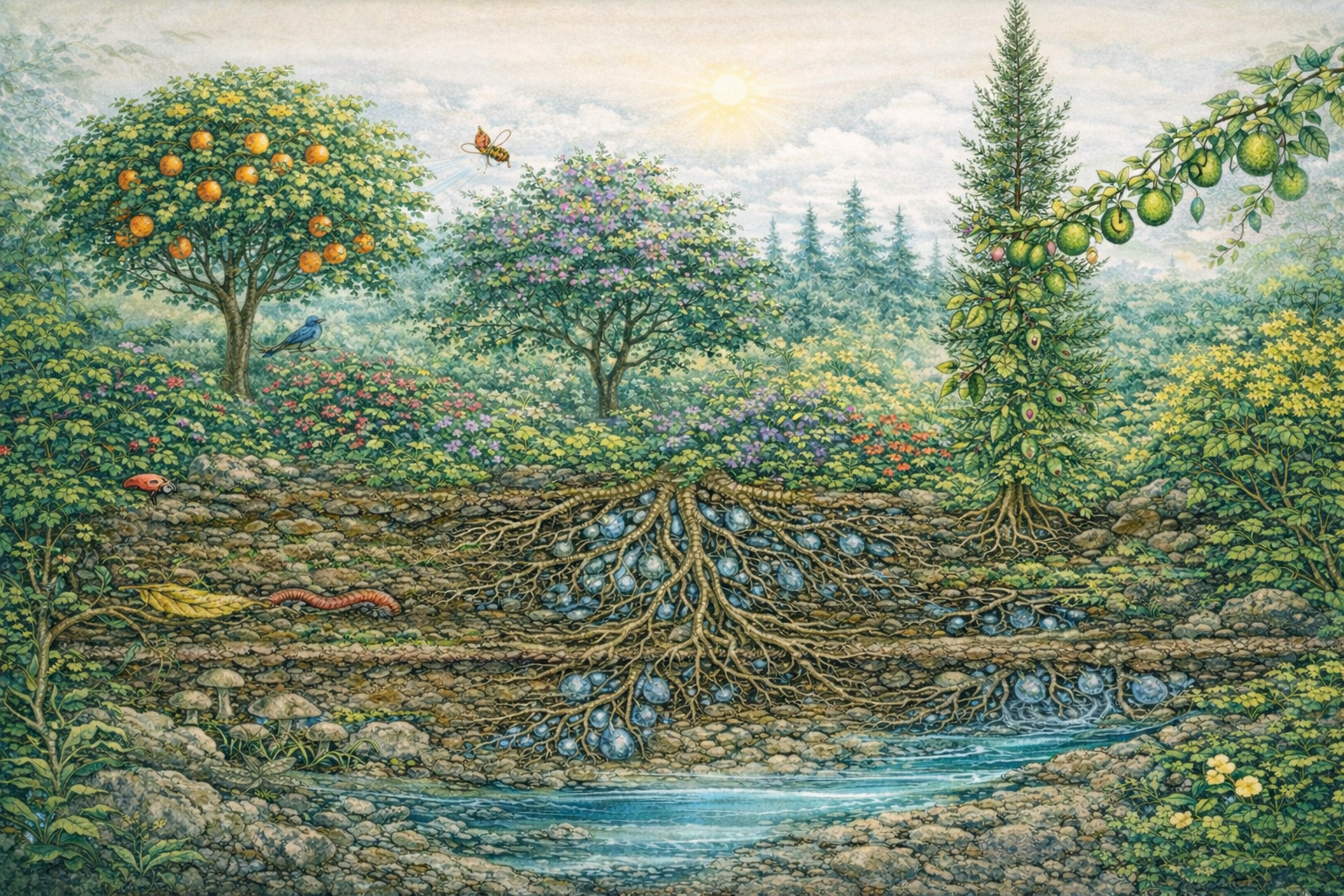
In a natural forest, plants don’t just sit next to one another — they interlock through space and time, forming an intricate, layered organism where every element has its niche and function. A food forest intentionally mirrors this vertical complexity by assembling edible and useful plants into distinct but interdependent layers — from towering canopy trees down through understory trees and shrubs to herbs, groundcovers, root crops and climbers — each filling a different ecological role and contributing to the whole system’s resilience and productivity. But unlike ancient forests that take centuries to balance themselves through slow patterns of succession, a thoughtfully designed food forest lets us accelerate this natural process, placing each “piece” of the ecological puzzle where it can interact, support and protect its neighbours. This invites experimentation and curiosity — mixing species, watching how they respond, and refining combinations — so that the system not only functions efficiently but continually teaches us through its ever-changing, dynamic life. This is where the art of design meets the wonder of ecology, and where lifelong gardeners find joy in play as much as in productivity.
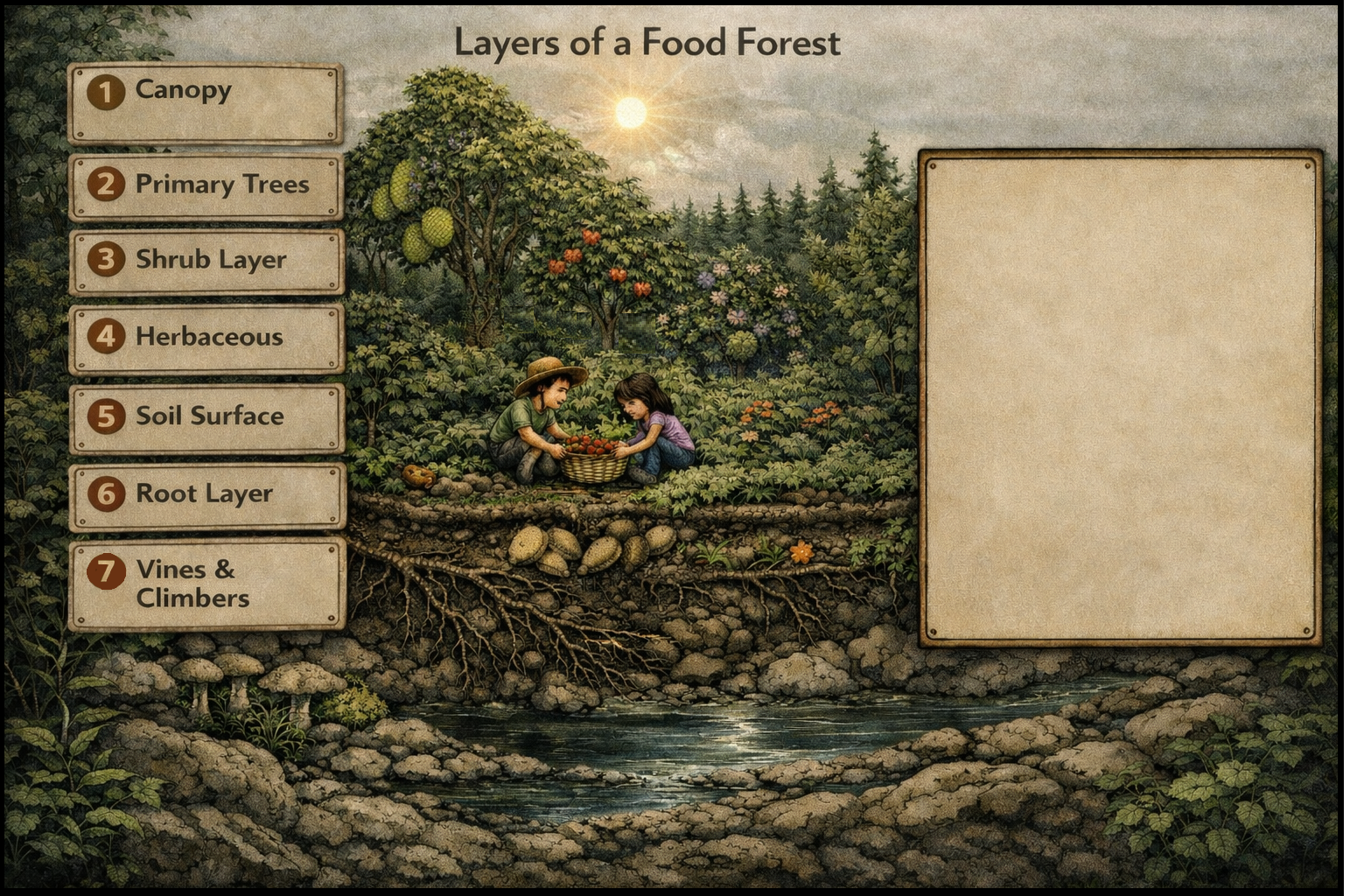
Food Forest Layers
Hover over a layer to explore its role.
Food forests are often described as productive, ecological, or beautiful — but in reality they tend to express patterns rather than absolutes. Over time, three dominant design tendencies appear again and again. These are not right or wrong approaches, but archetypes that help explain why some food forests feel orderly, others abundant, and others immersive and sensory.
A way to understand how food forests express themselves — and how to design with intention.
Most mature systems sit somewhere between them.
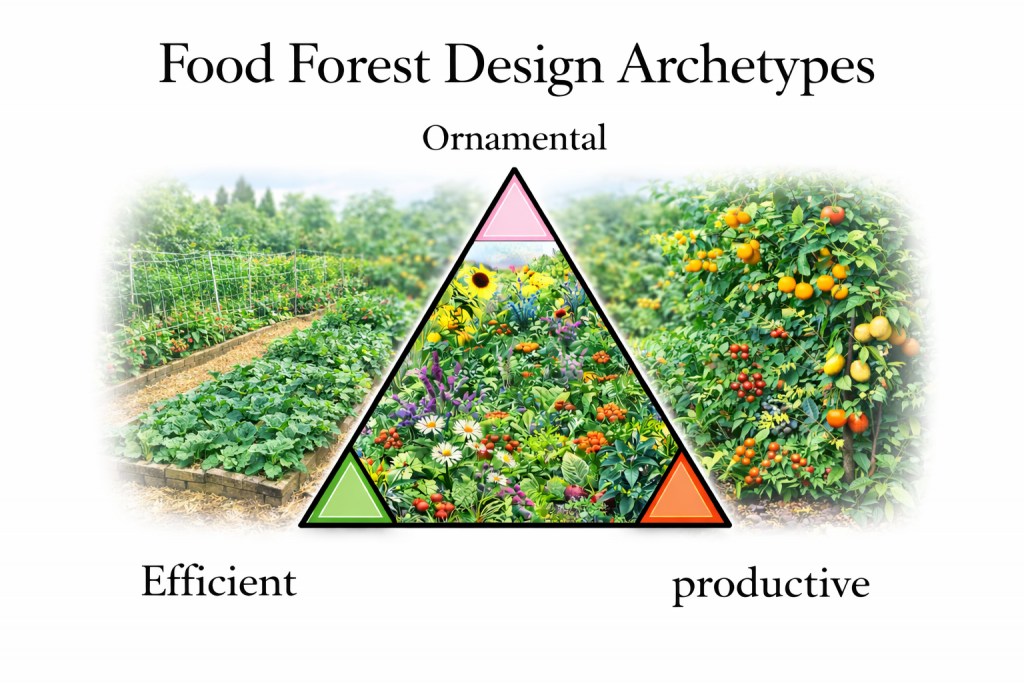
Efficient
What it looks like
Clear spacing, access paths, defined beds
Plants chosen for resilience and function
Easy to maintain, easy to scale
What it prioritises
Long-term stability
Labour efficiency
Self-regulation over intervention
Strengths
Survives neglect · Ages well · Teaches ecological literacy
Productive
What it looks like
Dense planting of high-yield species
Obvious harvest zones
Strong focus on output
What it prioritises
Food production
Reliability of harvest
Economic or nutritional return
Strengths
Feeds people · Supports livelihoods · Clear value
Ornamental
What it looks like
Flowers, colour, scent, texture
Layered abundance
Designed for wandering and noticing
What it prioritises
Human experience
Emotional connection
Pollinators and biodiversity
Strengths
Draws people in · Builds care · Encourages learning